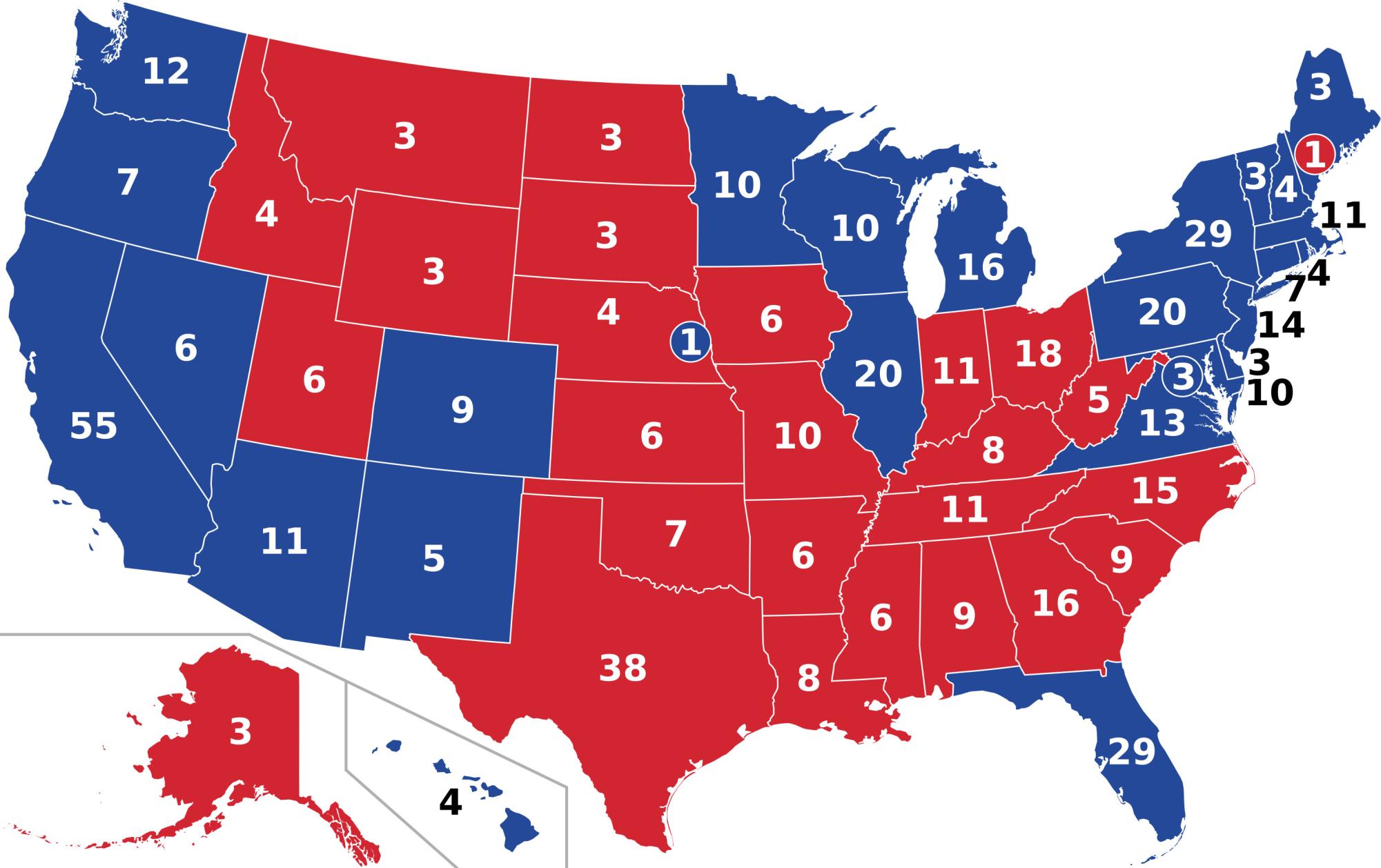

On April 13, Virginia Governor Abigail Spanberger signed into law a bill that made Virginia the 19th jurisdiction to sign onto the National Popular Vote Interstate Compact, or the NPVIC. If enacted, the NPVIC would change the way the president of the United States is elected, circumventing the Electoral College by having all member states cast their votes based on the national popular vote rather than that of the state. Virginia’s allocation of its 18 votes brings the compact to a total of 222, just 48 electoral votes short of the 270 that would trigger its installation.
Under the current electoral system, states individually cast votes based on their popular vote, all but two in a “winner takes all” format. Because of this, the winning candidate is not always the one who receives the most votes, as seen five times in US history and most recently in the 2016 presidential election. Back when the Constitution was written, this format was intended to protect individual state interests, as well as prevent the vote of smaller states from being silenced. Ironically, the system still results in certain votes being silenced, as most states largely favor one party over the other, effectively making the votes of the other party irrelevant. Additionally, this concentrates candidate focus on swing states only, often causing states that are considered “predetermined” to get much less engagement on the campaign trail. In the 2024 presidential election, just seven states considered “battlegrounds” received 94% of campaign attention, according to FairVote’s event tracker.
The argument in favor of the NPVIC is simple: no one American vote should count more than another. The president of the United States represents everyone in the country and is a national decision, and for this reason should reflect who the majority of voters nationwide want to hold the office. A Republican vote in Massachusetts and a Democratic vote in Oklahoma should count the same as every other vote, and the presumption that they do would likely result in higher voter turnout in these currently “predecided” elections. According to a study conducted by the Pew Research Center, 63% of Americans would like to see the winner of the presidential election be the candidate who receives the most votes nationally.
A change of this magnitude via the Constitution would require significant action in Congress, so the compact successfully avoids this issue by serving as a state agreement. Nonetheless, this format creates other possible legal issues, as opponents of the compact argue that it directly violates the Constitution, citing the process described in Article V and the Constitution’s Compact Clause. States do have broad control over how electoral votes are cast, and the issue of whether every interstate compact requires Congressional approval has never formally been determined by the courts, meaning a Supreme Court case would be ultimately decisive.
A national popular vote would also create potential problems with recounts, as expansion to recounts in multiple states at a time could increase pressure and delay decisions. While this is a possible situation, national margins are often much larger than state margins due to their size, so this situation is not as likely. Finally, critics claim that changing the system would switch campaigns to focusing on densely populated urban centers, reducing attention in more rural areas. However, this makes sense; candidates should prioritize reaching the most people, and the popular-vote format is likely to divide focus more evenly among the 50 states.
In the end, the enactment of the NPVIC would create genuine equality among voters and would ensure the President represented the interests of the voting majority. Still, no changes can go into effect until the compact reaches the 270-vote requirement, which would require entry from at least a few more states. Further, even if it reaches the vote requirement, the agreement is likely to see legal challenges and a key Supreme Court ruling before the US is fully switched over to a popular vote for president. To learn more or see how you can take action, visit https://www.nationalpopularvote.com/.