
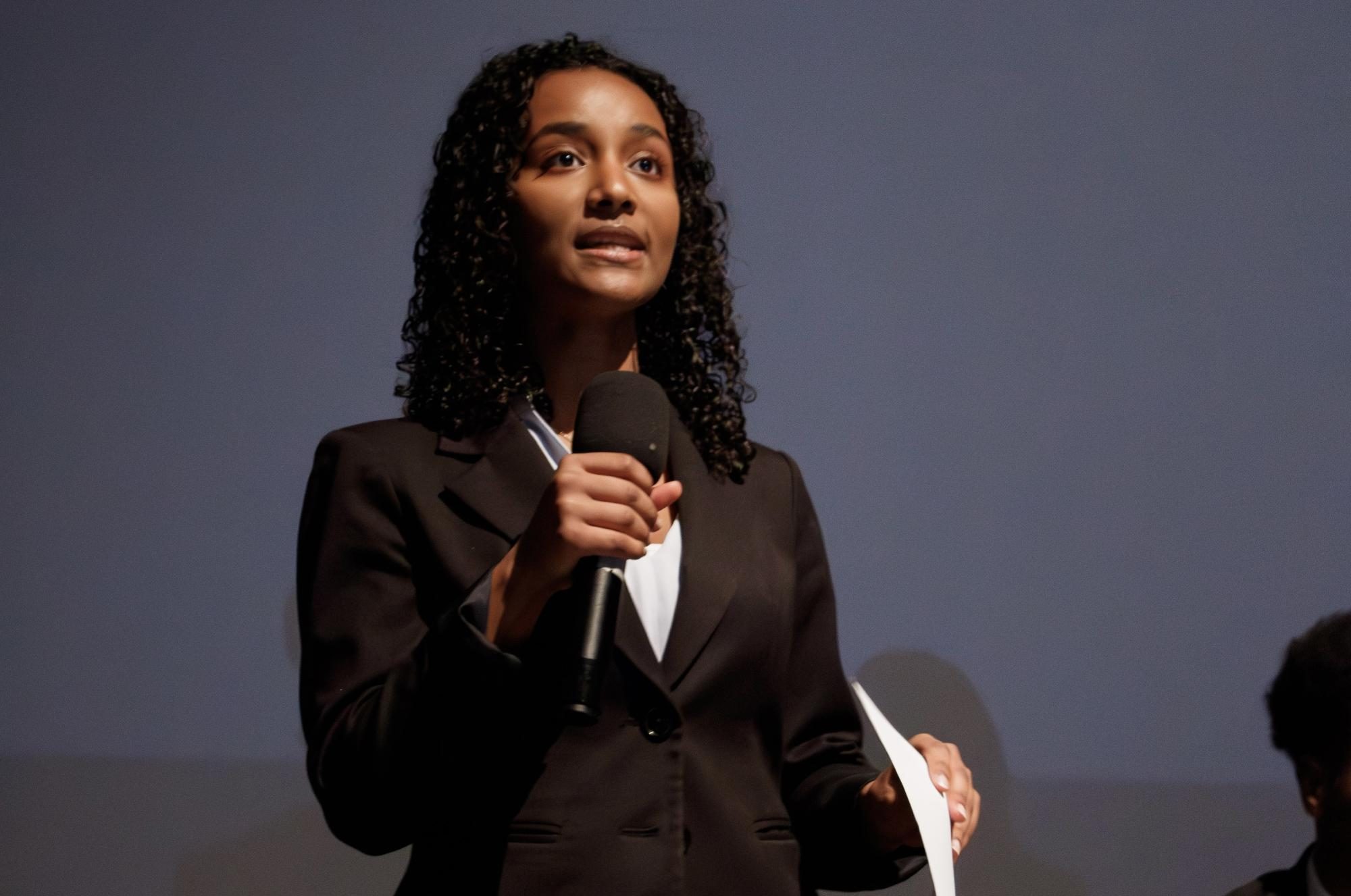
Montgomery County students hear about “student voice” constantly, but for Walter Johnson junior Reemey Ghermay, the problem is that students still don’t feel heard. Now, she’s running for Student Member of the Board (SMOB) to change that.
Since 1978, MCPS students have had the opportunity to run for the coveted Student Member of the Board position, which is a high school student elected to serve as a member of the Board of Education. They represent the voices and interests of over 160,000+ students in Montgomery County, voting on budgets, policies and school closures while receiving a scholarship, Student Service Learning hours and an honors-level social studies credit.
The SMOB Nominating Convention took place on Feb. 11, and is a pivotal event where student delegates from each middle and high school gather to hear speeches, evaluate candidates and eventually narrow the eight candidates down to two. This school was represented by six students: juniors Edlawit Abebe and Catherine Bucsa, seniors Charlie Rollins, Ryan Shin and Grant McGraw and this writer, senior Ahmed Ibrahim. The eight candidates were whittled down to the finalists: Walter Johnson junior Reemey Ghermay and Northwood sophomore Luel Dawit. “When I was looking to vote, I mainly looked at how confident I felt a student would bring actual change to our county and the many issues that it has,” Shin said.
Following the convention, Ghermay continued to center her campaign on one core idea: closing the gap between students and the Board of Education. “I feel like there’s been a disconnect with student voice. Students don’t really know what’s happening, and they don’t always have a clear way to speak up about it,” Ghermay said.
To address this, Ghermay proposed to revive the “SMOB Monthly Minute,” a tradition that current SMOB, Blair senior Anuva Maloo, has seemingly dropped. The Monthly Minute is a short video update sent to schools each month outlining Board decisions and offering students a direct way to reach out. She also emphasized increasing school visits and working more closely with each school’s student governments to ensure concerns from across the county are heard.
Beyond communication, Ghermay’s platform focuses on everyday issues that impact students across MCPS, including school safety and the condition of bathrooms. “Bathrooms are consistently closed, or they don’t have the supplies students need. It’s something that impacts every student, and it’s been an issue for years,” Ghermay said.
She connected these concerns to broader safety policies, pointing to inconsistencies in how rules like ID enforcement are applied across schools. A major point of Ghermay’s campaign is that clearer and more consistent expectations would help students feel safer in their environments.
Another major focus of her campaign is improving access to school meals. Drawing from her own experience with celiac disease, Ghermay highlighted the lack of options for students with dietary restrictions. “Every student deserves to know that they can go to school and have lunch,” Ghermay said.
Her proposal would require schools to include options accommodating major allergens each day, ensuring that students who rely on school meals are not excluded. According to Ghermay, rather than requiring major new funding, the solution lies in better utilizing resources already available. The issue revolving around school lunches is a major one in her campaign, one scroll through her social media makes it impossible to miss. Ghermay has celiac disease, which means she cannot eat gluten. Ever since third grade, she hasn’t been able to eat school lunches.
On the meal viewer website, the click of a button can show you every food that is free of dairy, nuts, fish and six other allergens. There is no gluten button because there “aren’t any gluten-free options in our cafeteria. That’s unacceptable, especially for students who rely on school lunches, of which 40% of MCPS students are. It’s unfair to have lunches that aren’t accessible [to everyone.] I want to enforce making it so that the top five allergens have to be present on every school’s [menu,]” Ghermay said.
Ghermay also emphasized the need for more equitable infrastructure and opportunities across MCPS. From outdated facilities to uneven access in academic programs, she said the county must take a more intentional approach to supporting schools with the greatest need. Her focus on equity extends beyond facilities, including expanding college and career readiness opportunities so that students across all schools have access to similar resources and support.
Much of Ghermay’s approach is shaped by her experience in student leadership. She has been involved in county-wide advocacy for years, including participating in the Montgomery County Junior Council (MCJC), Montgomery County Regional SGA (MCR) and her own school’s student government, where she worked with students across MCPS. “My platform is the platform of the students. It’s about listening to what they need and using that to guide every decision,” Ghermay said.
For students, those qualities are what define her candidacy. Junior class president Manasa Iyer, who worked with Ghermay in MCJC, described her as both approachable and willing to advocate strongly for others. “She’s very kind, and she’ll listen to you, but she’s not afraid to take a stand. If something is important to students, she’ll fight for it, no matter what,” Iyer said.
At this school, where recent events have heightened conversations around school safety, students say those issues are especially important when evaluating candidates. “I chose to vote for someone that I wanted to represent Wootton’s values; something we had just endured was the school shooting. I want to ensure that [whoever] was going to be in office was adequately representing the needs of student safety,” Rollins said.
Ghermay acknowledged the impact of these concerns across the county, emphasizing the importance of ensuring students feel safe and supported in their schools. That all starts with consistent policies, clear communication and making sure students know their voices are being heard.
For Ghermay, the role of SMOB is not just about sitting at the table; it’s about making sure students feel like they belong there. Whether it’s fixing something as overlooked as a bathroom or as systemic as inequitable resources, her campaign circles back to the same idea: students shouldn’t have to fight to be heard in a system built for them.
In a race for a role that is defined by who can turn student concerns into real change, Ghermay is betting that consistency, communication and follow-through will matter most. And for a county where students are increasingly demanding both transparency and action, that may be exactly what they’re looking for
You can follow Ghermay’s SMOB journey on all social media platforms through @reemay4smob.