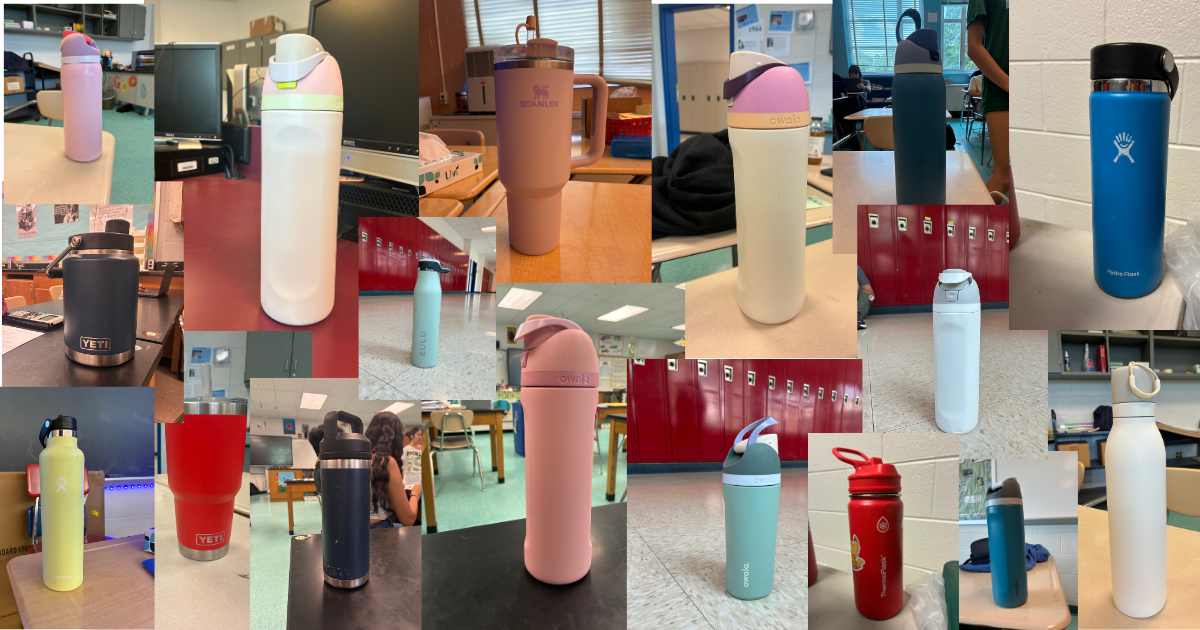

Students wake up every morning and get ready for the day, with some grabbing a quick-packed lunch and others opting not to eat during school lunch times. Regardless of lunch choices, one aspect of school that can be seen throughout students, safely tucked inside backpack pockets, is water bottles.
Students may opt to bring their own water bottles to school due to efficiency and for hydration reasons, allowing for students throughout the day to have access to water whether in class or between periods. From plastic disposable water bottles to metal tumblers, a wide variety of water bottle types and brands are seen.
Owala
Owala is a relatively new company that originated in Utah and started in 2020 by CEO Steve Sorensen, after he wanted to create a water bottle that customers could sip and drink from upright. His vision came to fruition when he, along with his parent company Trove Brands, invented the patented FreeSip, which allows users to drink upright without tilting their head back, a common habit when drinking from most water bottles. This function kickstarted the brand and led to Owala’s huge popularity among reusable water bottle users, with Time even naming Owala water bottles one of the best inventions in a 2023 article. Another aspect of Owala that appeals to customers is their unique and wide variety of color combinations. “I love my Owala,” junior Ellie Fang said. “My favorite part of the bottle is that it comes in really unique color patterns that I normally wouldn’t think would look good together, but end up working really well. For example, I have a purple and gray bottle and normally I wouldn’t think those colors would look good together, but I love it for my Owala. I also like that I can just pick it up and drink from it, it’s super efficient.”
Hydroflask
Hydroflasks were made infamously popular during the late 2010’s by the VSCO girl trend, which was a style that first started in 2019 popularized by wearing scrunchies, Birkenstock sandals, and, most notably, Hydroflask water bottles. The Hydroflask was the main accessory necessary to master the beachy-themed style, but since then, its popularity has significantly decreased compared to their peak years of popularity during the VSCO trend. “I remember in middle school I had a Hydroflask and I would put stickers on it,” junior Ava Nieto said. “I don’t really see many people using them nowadays since the VSCO girl trend that happened in middle school. They’re just not really that popular anymore.”
Stanley
Stanley water bottles are tried and true water containers that have been around even longer than Hydroflasks or Owalas. Originating in 1913, American inventor William Stanley Jr. patented it as the first all-steel, double-walled vacuum bottle. The bottle was originally made for blue collar workers to keep their coffee warm, but bottles nowadays are used to store cold liquids like water. Stanley’s most popular design is their tumbler, which comes with a handle and straw. “I have two Stanley’s, but I think that they’re less popular than they used to be a couple years ago,” junior Meara Liebetrau said. “They are also pretty expensive and since they have straws they tend to leak, so I don’t bring mine to school.”