
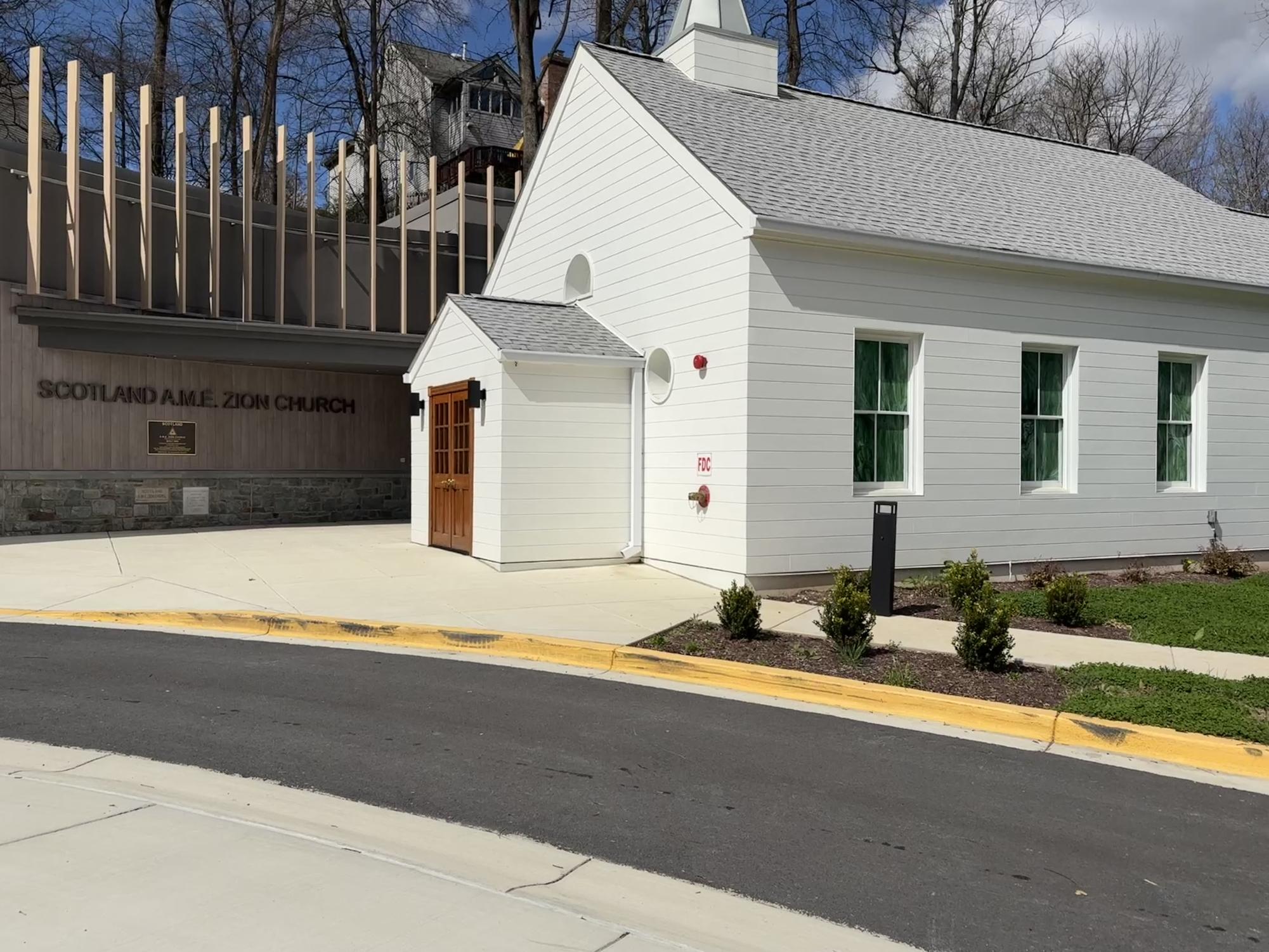
A long white brick building, with a stout steeple, blazing green windows and a newly renovated stone wall with a sign adorning the name “Scotland A.M.E. Zion Church” perches off the side of Seven Locks Road. Passersby only scratch the surface in seeing this historic church, as the roads and neighborhoods they drive through surrounding the church have a deep and rich story waiting to be told.
The foundation of the Scotland community began in 1880, when former slave William Dove bought 36 acres of land, becoming one of the first African Americans in Montgomery County to own land. Following in his footsteps, freed slave James William Harris bought 44 acres, then in 1884 brothers Noah and Augusta Mason bought 15 acres of land. The developing community was known at the time as “Snakes Den” until in the 1920s when it took the name Scotland.
The community experienced racism and gentrification from developers who threatened to destroy the existence of the community in the 1950s in wanting to develop white neighborhoods or expand the Cabin John Regional Park. Through the “Save our Scotland” campaign the neighborhood fought for better living conditions, necessary public services and protection against displacement. The community centered around the Scotland A.M.E. Zion Church, which was built in 1924 as a way to embrace the strength of the neighborhood and fight against those trying to displace them.
Gaining traction, the “Save our Scotland” campaign caught the attention of public figures like President Lyndon B. Johnson and HUD Secretary Robert Weaver, America’s first Black cabinet member. The relentless support of the campaign resulted in the signing of the Housing and Urban Development Act in August 1965. This act gave way to Scotland becoming the first recipient under the program. With 36 acres of their land, they created townhomes, which offered a mix of low-interest mortgages and federally subsidized rent for residents. This act nationwide helped to improve housing for low to middle income families by promoting urban development and living environments in urban areas.
The Scotland community now includes 100 townhouses on Scotland Drive off of Seven Locks Road where 25 of these homes are still owned by descendants of original founders. The strength and resilience in the history of the Scotland community are still central to the neighborhood today with celebrations during February for Black History Month and on Juneteenth to remember and highlight the empowering stories of the community’s ancestors. The church, which in 2019 was devastated by a flood, has been renovated and today remains a pillar in the community serving as a reminder of the tenacity of the community as developers and county officials tried to take away their homes.
Descendants of Dove – LaTisha Gasaway-Paul, Teresa Gasaway-Gleaton, and LaTrice Gasaway-Johnson – remain active advocates in their community, trying to reclaim land that was claimed to be taken from Dove through eminent domain and discriminatory practices. They plan to take back these county-owned portions of land formerly entitled to Dove to create affordable housing for descendants of those who’d been displaced.
Scotland isn’t the only community in Montgomery County founded by freed slaves, though others were erased by developers looking to infringe on the land. The Gasaway sisters, as they are known locally, hope to do their part in bringing back these communities by building housing for those displaced.
Remembering the history and the perseverance of the Scotland community, is an integral part of the country’s and the county’s history. Implementing units on the Scotland community in MCPS curriculum is a way that the tribulations and the triumphs of the neighborhood are remembered and exemplified. MCPS has included lessons on the Scotland community in its Reconciliation and Remembrance unit featured earlier this year in November. With the proximity to the historical Scotland community, “students who get the opportunity to learn more about their local history become more engaged members of their community,” Cabin John middle school social studies teacher Joanna Gottesman said.
Within the Reconciliation and Remembrance unit, there are five lessons sourced from local history that are presented annually. Though these topics vary, highlighting the Scotland community, which boasts proximity and close association to MCPS students’ families, there is a strong connection to the content. “It’s important to me because I can learn about my family and how they helped build the Scotland community,” Cabin John eighth grader Makayla Bellamy said.
Lessons on the Scotland community have yet to extend into the curriculum for high school history classes. “I’m not aware of much in the curriculum dealing with the Scottish community in Montgomery County,” social studies teacher Timothy Anderson said.
Adding permanent units on the Scotland community into history courses would ensure that the neighborhood’s fraught, yet admirable history remains taught to students each year. Beyond even the Scotland community, there are stories of the past that are integral parts of the communities foundation, yet remain little known and forgotten. In Bethesda, the Josiah Henson museum focuses on the life and impact made by abolitionist, author, minister and inspiration for Harriet Beecher Stowe’s Uncle Tom’s Cabin, Josiah Henson. Like that of Henson, Dove is a crucial part of a long-standing community that is still celebrated today. In continuing to teach and share the stories of communities like that of Scotland, their legacies can live on.