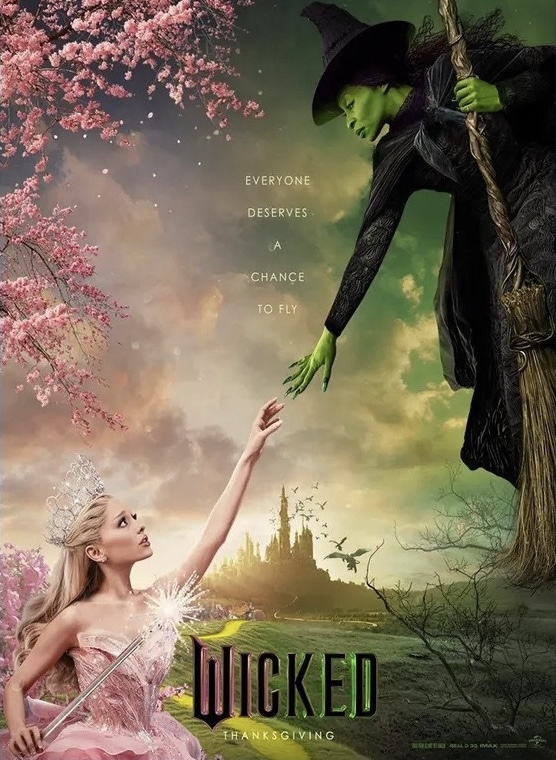
After seeing part one of “Wicked” last year, I was looking forward to seeing “Wicked: For Good,” once it hit theaters on Nov. 21. Although the film’s rich storytelling, star-studded cast and ability to seamlessly adapt the Broadway show were compelling, “Wicked,” is also notorious for its social commentary and relevant themes, both of which I found to be overlooked focal points within the new movie.
In both movie parts, but particularly “Wicked: For Good,” animals are oppressed by figures of authority, silenced and systemically removed from society, which feels eerily familiar to current ICE deportations.
In the song, “No Place Like Home,” a new addition to the soundtrack, inspired by the “Wizard of Oz,” protagonist Elphaba Thropp (Cynthia Erivo) grapples with the state of Oz. Referring to Oz as a promise and an idea, rather than a geographic vicinity, is reminiscent to the American Dream. Throughout the song, Thropp expresses her frustration and resentment toward Oz while expressing deep messages of hope and patriotism. Paralleling this, hope can be powerful amidst increased feelings of fear and animosity within the political polarization present in the .US. today.
Nessarose Thropp (Marissa Bode) uses her role as Governor to prohibit travel between Munkinland and the affluent Emerald City for Munchkins, to ensure Boq Woodsman (Ethan Slater) stays by her side, demonstrating how government officials can abuse power.
“Wicked: For Good,” with the capacity to draw large audiences, holds a significant political role. While concurrently exemplifying real-world issues, movies like this can increase public awareness to ensure Americans hold government officials accountable.
Discourse over the implications of the Wizard’s web of lies upholding his regime is a central fixture within his and Thropp’s animus relationship. Within the present political climate, controversy regarding the truth versus the accepted narratives that diverge from it is an unfortunate reality. Because of this, the Wizard’s regime relies on propaganda to scapegoat Thropp as the Wicked Witch. Glinda the Good’s (Ariana Grande) submission to the Wizard’s regime in exchange for her favorable public persona symbolizes the temptation to adhere to accepted norms. These two distinct experiences exemplify the power the government has in its ability to control public opinion and the importance of combating misinformation. As students are the future, it is of the utmost importance to bolster political literacy to mitigate the disruption of the normalizing misinformation. This could mean seeking a deeper understanding of the political climate by relating ideas from inside the classroom to contemporary ideas.
Sitting down at the movies or on the couch with an overflowing bucket of popcorn to watch “Wicked: For Good,” fans may be prepared to spend the next approximately two hours enjoying this highly-anticipated, fun film while escaping from day-to-day challenges. In doing so, one might miss these relevant themes that masterfully align with U.S. politics. Politics and art have a subtle tie, but if one can identify the strong connections between artistic endeavors and current events, they are almost unimpossible to unsee.