

For years, Montgomery County (MoCo), Maryland, was known as the fastest-growing area in the DMV. But in recent years, the population has decreased. This shift has not only stirred concerns throughout the county but also all of Maryland. MoCo is a model that predicts Maryland’s population as a whole, and the rapid population decline has reached the governor’s desk.
According to data from the U.S Census Bureau, MoCo experienced a noticeable drop in population between 2020 and 2021. One report states that the county’s population “dropped 0.5%” during that time period, according to USAFacts. Another source, Moderately MOCO, explains that 2021 was “the first negative population change since 1979.” These two sources not only show the population decline but also its severity.
One major reason for Montgomery County’s population decline is people moving away from the area. Even with MoCo being nationally ranked in education and safety, people have moved because of factors like the high cost of living, housing prices, or job opportunities in other areas. Even though some people are still moving into this country from other countries, more people are leaving for other parts of the U.S., with recent data saying” about 9,400 more people” moved out than moved in domestically, according to USAFacts. This suggests that factors such as those above might be pushing existing residents and new ones.
The COVID-19 pandemic also played a role. Between 2020 and 2022, the region lost over 29,000 people through deaths and relocation to more rural areas, according to Montgomery planning. Even though the population has started to recover from this pandemic, it still hasn’t fully recovered to pre-pandemic levels. “COVID made all of us go out for school for a long time, and I think it is still affecting all of us, including the population,” sophomore Reed Gottesman said.
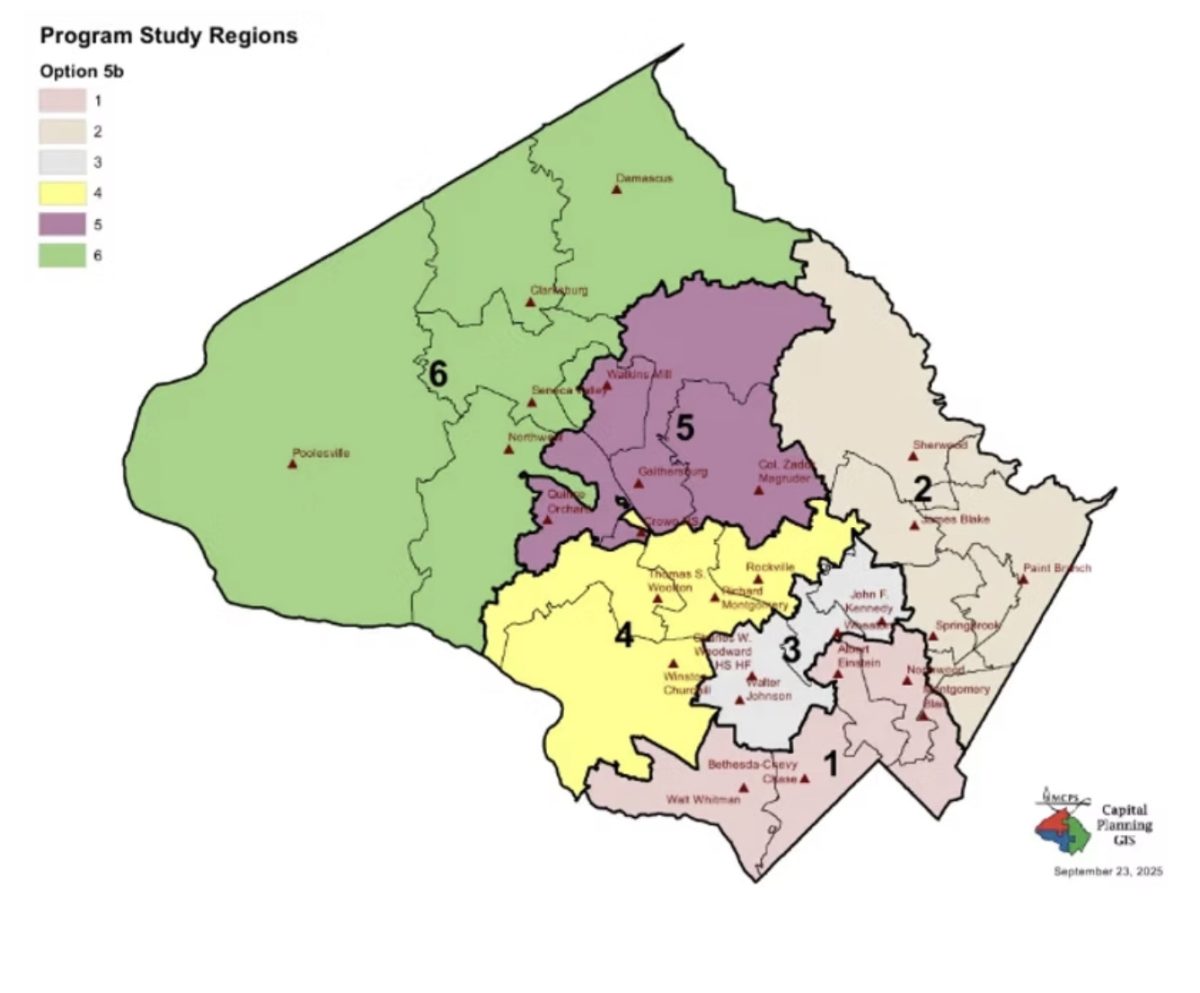
The decrease in new families in the area not only impacts the housing market, but also schools and the residential lines for those schools. For example, this school was predicted to gain enrollment from 2019, but with the lack of new families in the area, the enrollment rate went down by 3%, according to Bethesda Magazine. This lowered this school’s sports division down to 3A in the 2023-2024 school year, despite the school being in 4A for over 30 years with a continual population of over 2,000 students. In the 2023-2024 school year, Wootton only had 1,875 enrolled students. “The change of moving from 4A to 3A doesn’t really have a difference, but not always playing against Churchill and Whitman is annoying,” freshman Grant Scofield said.
This school’s move to the new Crown site is a result of the lack of population in MoCo, according to Bethesda Magazine. Wootton was predicted to gain an increase in enrollment in 2019, according to the Montgomery Perspective, and the reconstruction of the building was set to begin in 2027-2028 in the 2019 MCPS construction plan, according to Bethesda Magazine. But the enrollment, instead of increasing, decreased significantly. “I like being able to move to the new school, but the decrease in population will split the neighborhoods and friends going to other schools due to not wanting to go to the Crown by applying for a COSA (Change of School Assignment),” sophomore Jack Sisco said.
Looking ahead, Montgomery County’s population could go in a few different directions depending on how current trends change. If problems like housing and job opportunities worsen and push residents out of the area, the population may continue to grow slowly or even decline again. However, if the county invests in these problems, affordable housing, job opportunities, and community development, and attracts new families, the county can return to steady growth, with some projections predicting 1.12 million – 1.15 million residents by 2030, according to Montgomery Planning.