For students taking AP Seminar, the curriculum will be structured a bit differently this year than in previous ones. Due to a scheduling issue, students may see their AP Seminar teacher and period change between the first and second semesters, a deviation from the typical procedure due to the course’s timeline.
To accommodate these changes, AP Seminar teachers at this school took two professional days in October to rework elements of the class’ curriculum. This school’s AP Capstone Program Director Michelle Hanson, who has taught AP Seminar for eight years, said this reorganization created a “condensed schedule” that will maintain the quality of the course for students while ensuring their timeline aligns with the semester change.
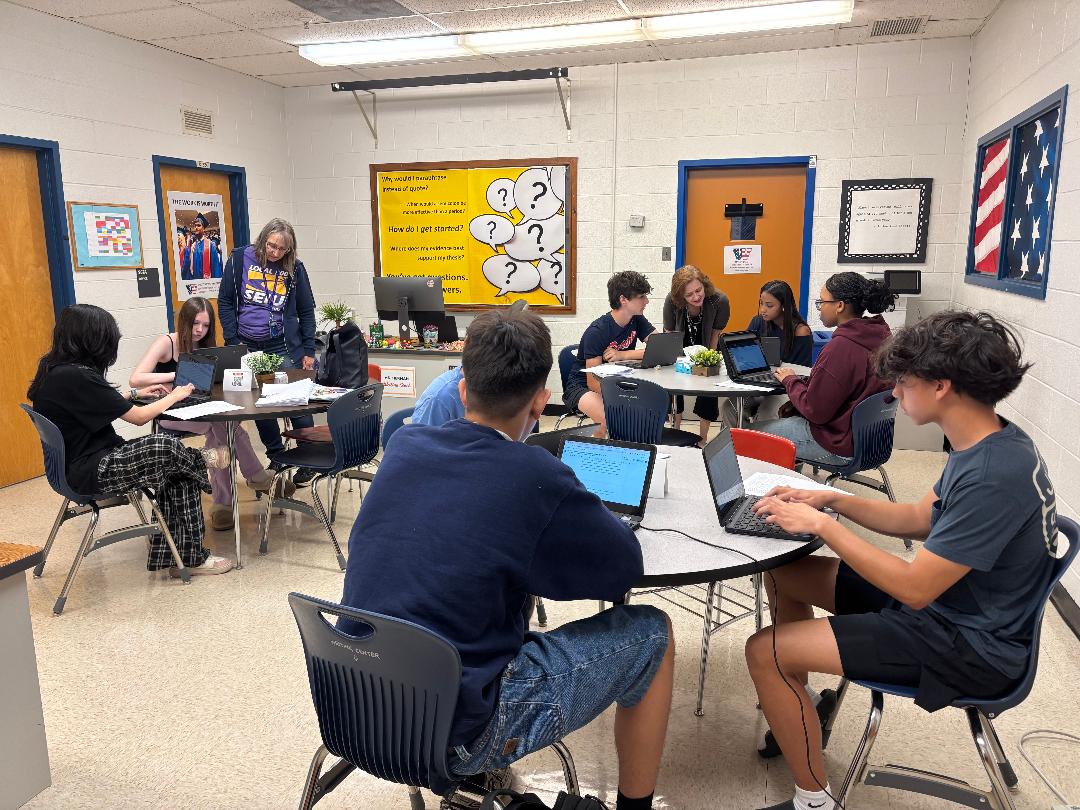
AP Seminar exam scores are comprised of three primary elements: Performance Tasks 1 and 2 (PT1 and PT2)—which are responsible for 20% and 35% of one’s score, respectively—and a traditional written exam, taken in May, which makes up the remaining 45%. The exam is individual, as is PT2. But, PT1 is composed of two elements, an Individual Research Report (IRR) and a Team Multimedia Presentation (TMP), the latter conducted in groups of four to six students. At this school, the AP Seminar curriculum includes lots of background work on elements of the IRR and TMP before beginning PT1, as well as a mock-PT1 in small groups. It is this aspect of the course that has typically required students to remain in the same AP Seminar class over the full year; at the semester break, students are midway through PT1, meaning they need to remain together with their groups in order to complete the project.
On Oct. 1, parents and guardians of AP Seminar students received a memo through ParentVue from Assistant Principal David O’Shell informing them that although in the past it has been “recommended, but not required” for students to remain in the same period of AP Seminar across semesters, this was not possible this year “due to scheduling constraints.” O’Shell noted that “this adjustment requires a modification to the pacing of the course,” and as such, AP English 10 Seminar teachers were using two professional planning days to “revise their pacing guides.”
The scheduling constraints mentioned by O’Shell were actually a combination of scheduling circumstances. In past years, counselors who knew about the course’s requirements had often hand-scheduled students into the same AP Seminar period for the second semester as the first, particularly as the number of students enrolled in the course increased from around 70 to nearly 270 last year when it was made available as a 10th grade English class. However, with high recent administrative and faculty turnover, student schedules, which are typically created the previous spring, were incomplete when Assistant Principal Heidi Vermillion took over the responsibility earlier this year. “Ms. Vermillion now is our master scheduler, and she’s well-known in the county for being very good at this,” Hanson said. “There were so many problems with the way [schedules] had been set up that she felt that it was better to start from scratch… Anything that wasn’t put into the system disappeared. A lot of the kids had been hand-scheduled in… but there was no way for her to be able to know that.”
Once the problem with student schedules became apparent, AP Seminar teachers Melissa Kaplan and Catherine Boswell said administration met promptly with the course’s teachers to address the issues. “Ms. Vermillion was very transparent about the difficulties in reopening the scheduling program,” an obstacle that was in the hands of MCPS, and out of control of both administrators and teachers, Kaplan and Boswell said.
The sheer number of kids affected, in addition to the complexity of their schedules and difficulties with the county’s scheduling program, presented a tricky situation, one exacerbated by the fact that classes are currently full, meaning it wasn’t possible to simply hand-schedule hundreds of students. “We had some scheduling barriers, which prevented the counseling team from being able to rework the students’ schedules,” Vermillion said.
Hanson reiterated that the situation was outside of anyone’s control. “We just had kind of a perfect storm of events… because of the crowded classes, the new second semester schedule, and just not knowing that this is the way that we had done things in the past,” Hanson said. “It wasn’t anybody’s fault.”
To rectify the scheduling issues then, teachers and administrators had to think outside of the box. Kaplan and Boswell said that the decision teachers came to, to rework the course’s schedule, was the best solution given the circumstances, a sentiment that Hanson agreed with. “I felt that the other alternative was to have the kids come during advisory and lunch to meet with kids from last semester to create the presentations. And that just didn’t seem workable or fair,” Hanson said.
After the two professional days provided by administrators for the task of adapting the class’ pacing, the AP Seminar teachers settled on a schedule that prioritizes completion of the TMP before the end of the first marking period by moving elements of the IRR and other individual assignments to the second semester, while also focusing on maintaining the integrity of the mock PT1. “The timeline for PT1 has been accelerated by approximately a month,” now finishing at the end of the first semester as opposed to the end of February, Kaplan said. “While we will be able to cover all the skills, each unit did have to be abbreviated.”
As for what specific changes students can expect, some of the abbreviated aspects include areas like research questions and synthesis. The more extensive practice of these skills, which has typically been included in the course’s first semester, has been moved to the second semester, still before the exam but now after TMP presentations are finished. Hanson said students will still be adequately prepared for the performance tasks and exam, just with a different timeline. “It’s not the way we’d like to do it, but it’s workable,” she said. “I don’t expect our scores to fall because of it. I think that we’re going to be able to do what we need to do.”
Although news of the scheduling changes was initially met with apprehension from AP Seminar teachers, who were already a few weeks into the school year when they found out, the new structure and plan has relieved some of that stress. “All of us were very concerned at the beginning because it was kind of a shock to the system, really,” Hanson said. “I think there was a sense of ‘Oh my gosh, how are we going to do this?’ But when [we] sat down and really went over everything, we became much less nervous.”
In order to reduce the risk of this problem arising again, administrators will be more cognizant of AP Seminar students’ scheduling needs in the future. “The scheduling team will discuss this issue when building next year’s schedule in the spring,” Vermillion said.
However, this year, despite the challenge of implementing the reorganized schedule in AP Seminar classes, Hanson said that although it was not an ideal situation, she believed the quality of teachers and students here would help make the adjustment smooth. “We just want the kids to feel comfortable and confident about what they’re learning, so it was quite a trick to sit down and figure out how to do it, but we’ve got some great people on the team and I’m pretty confident about how we’re handling it,” Hanson said.